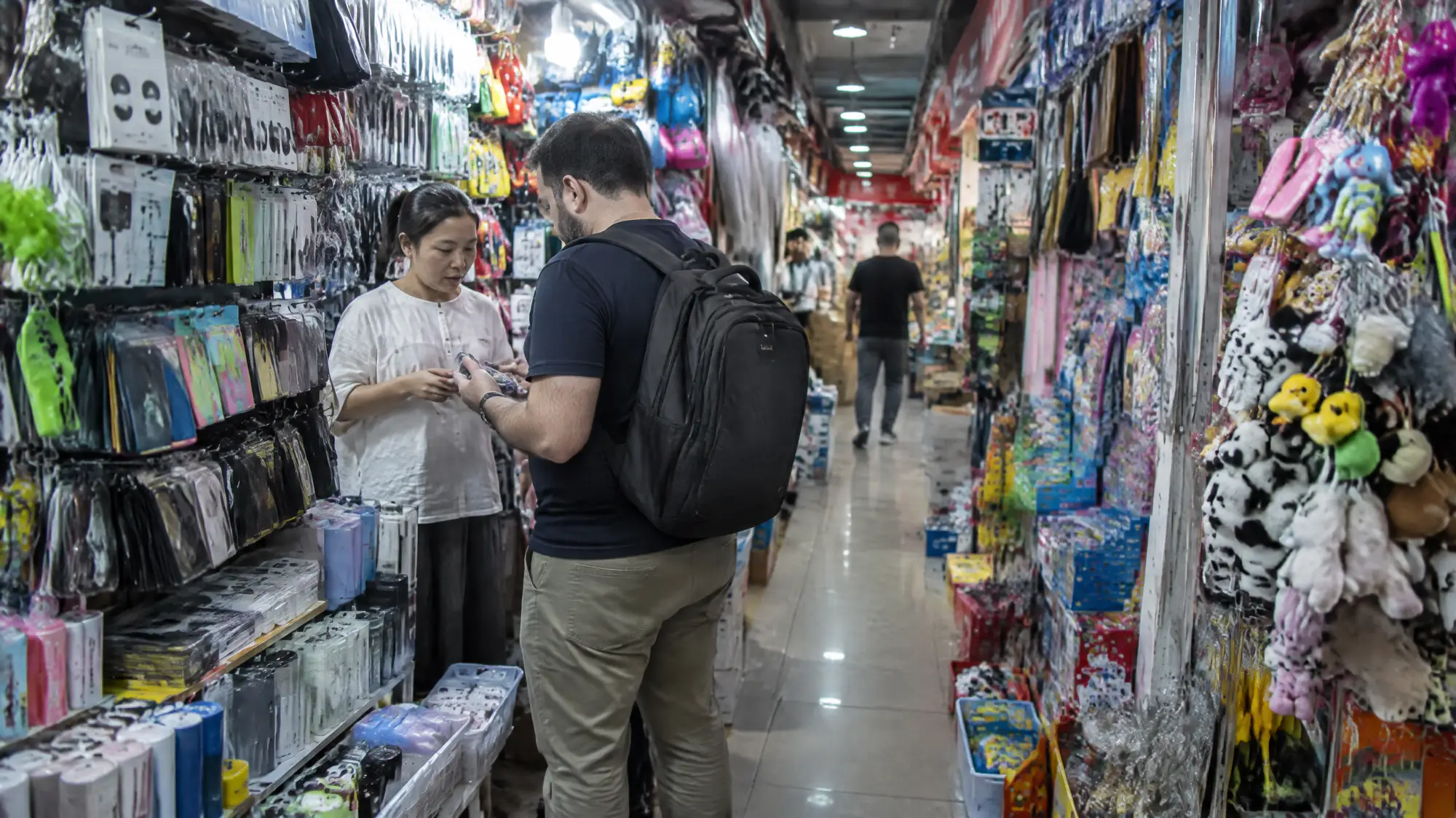
Yiwu is the world’s biggest small-commodity market, with tens of thousands of booths. Here is how it works, what to buy there and how to make a trip pay off as an online seller.
This Yiwu market guide in one paragraph: Yiwu International Trade City, in Zhejiang province, is the world’s largest wholesale market for small commodities, with more than 75,000 booths across several districts selling toys, jewelry, accessories, home goods, stationery, textiles and much more. It opens daily, roughly 9:00 to 17:00, and closes for a few weeks around Chinese New Year. Booths are mostly showrooms that take orders by the carton, and a local agent handles payment follow-up, quality checks and shipping.
For an e-commerce seller, Yiwu is a great place to discover products, compare dozens of suppliers in a single afternoon and negotiate face to face. It is also easy to waste a week there without a plan. This guide covers what each district sells, how buying works, and how to get your goods from a booth to your customers.
What is Yiwu market?
Yiwu is a city in Zhejiang province, about 300 km from Shanghai. Its wholesale market, Yiwu International Trade City, opened its first district in 2002 and has grown into a complex of connected buildings, each with several floors of permanent booths. Most booths are run by factories or trading companies that show samples and take orders, rather than selling stock off the shelf.
The market is famous for “small commodities”: low-cost, high-variety products that fit perfectly with many online stores. In October 2025, Yiwu opened the Global Digital Trade Center, often called District 6, which focuses on newer categories such as fashion jewelry, trend toys and smart devices, and connects booths to online trading and payment platforms.
Imported goods, bedding and home textiles, pet supplies, car products
District 6 (Global Digital Trade Center)
Fashion jewelry, trend toys, smart devices and other emerging categories
Layouts and floor assignments change as the market evolves, so check a current floor map when you arrive. Nearby specialized markets, such as the Huangyuan clothing market and the production materials market, can also be useful depending on your niche.
Is Yiwu market good for dropshipping and online stores?
It depends on your products. Yiwu is excellent for accessories, jewelry, home and kitchen items, pet products, party supplies, stationery, beauty tools and seasonal items. It is less deep for complex electronics, where Shenzhen suppliers usually have more expertise, or for fashion apparel, where Guangzhou is stronger.
Pros: huge variety in one place, many suppliers for the same product, easy price comparison, face-to-face negotiation, fast sampling.
Cons: many booths are traders, not factories; minimums are usually by carton; English is limited in some booths; quality varies and must be checked.
Best for: sellers who want to discover new products, build a catalog around one niche, or meet suppliers they already buy from online.
You do not have to travel to buy from Yiwu suppliers. Many are also on 1688 and on Yiwu’s own online platforms, and a local agent can visit booths for you. Our guide on how to buy from 1688 covers the online route.
How to buy at Yiwu market step by step
Prepare a product list with target prices, quantities and photos. Decide which districts to cover each day.
Walk the relevant floors on day one without buying. Take photos of products, price tags and the booth’s business card.
Shortlist two or three booths per product. Ask for price tiers, minimum order, production or restock time, and packaging options.
Negotiate on price, minimum, packaging and delivery date. Many booths accept mixed cartons across colors or models.
Place the order with a written order sheet listing quantities, specs, prices, packaging and delivery address. Keep a copy signed or stamped by the booth.
Pay a deposit, commonly around 30%, with the balance before delivery. Pay only the company named on the order.
Have goods delivered to your agent’s warehouse, where they are counted, checked against your samples and consolidated.
Ship. Either in bulk to your own warehouse, or stored in China and sent parcel by parcel by air to your customers.
What are typical minimums at Yiwu market?
Most booths sell by the carton, and their MOQ is usually quoted per model or color. Minimums for stock items are often lower than for factory production, and custom logos or packaging raise them. Negotiation works well face to face, especially if you mix models in one order or accept existing colors. Our guide on how to lower MOQ as a small seller gives specific tactics, and negotiating with Chinese suppliers covers the wider conversation.
When to visit and how to plan the trip
Opening hours: the market opens daily, roughly from 9:00 to 17:00. Many booths start closing earlier on quiet days.
Holidays: the market closes for around two to three weeks around Chinese New Year (6 February in 2027), and suppliers slow down for weeks before and after.
Best seasons: spring and autumn, when suppliers show new collections ahead of the peak selling seasons.
Time needed: two to five days for a focused trip covering a few districts.
Getting there: high-speed trains connect Yiwu with Shanghai and Hangzhou, and the city has its own airport.
Visa: rules change often. China has extended visa-free entry for many European nationalities until 31 December 2026, but check the Chinese embassy website for your passport before booking.
How to ship goods from Yiwu to your customers
Booths deliver within China, usually to a warehouse or forwarder in Yiwu. From there you have two main routes. For restocking your own warehouse, a freight forwarder consolidates cartons and ships them by air or sea. For dropshipping, goods are stored in China and each order is shipped individually by air to the end customer.
Either way, inspect before anything leaves China. Yiwu products are often low cost, which makes quality control essential: checking a batch in China costs far less than refunding customers later. Also remember customs rules at the destination: EU imports pay VAT and, since 1 July 2026, a temporary €3 duty per item category on parcels up to €150, and US low-value parcels have paid duties since the de minimis exemption was suspended on 29 August 2025.
Should you use a Yiwu agent?
Yiwu has many local agents, and the market is built around them. A sourcing agent can guide you through the districts, translate, negotiate, follow up production, collect goods from several booths and ship them together. If you cannot travel, they can visit booths for you with photos and video. Before choosing one, understand how sourcing agent fees work, because Yiwu agents use very different pricing models.
Your next step
List the products you want to source, check which district covers them, and decide whether you need to be there in person or can start with photos and samples through an agent. If you buy in Yiwu, you can have goods sent to Jindouyun’s Shenzhen warehouse for inspection, storage and air shipping to your customers, alongside the products you source elsewhere in China.
FAQ
Can foreigners buy at Yiwu market?
Yes. Yiwu market is used to foreign buyers, and many booths have staff who speak some English or use translation apps. You can place orders directly, but most foreign buyers work with a local agent who handles translation, order follow-up, payment of balances, quality checks and consolidated shipping from Yiwu.
Can you buy single items at Yiwu market?
It is a wholesale market, so most booths sell by the carton rather than by the piece. Some will sell a sample or a small quantity, especially if you show serious interest in a larger order. For single pieces for testing, online platforms like 1688 or AliExpress are usually easier.
Is Yiwu cheaper than 1688?
Not necessarily. Many Yiwu suppliers also sell on 1688, so prices can be similar. The advantage of Yiwu is comparing many suppliers physically, touching the products and negotiating face to face, which can lead to better terms for larger or repeat orders. For small quantities, 1688 is often just as competitive.
Is Yiwu market open every day?
The market opens almost every day of the year, roughly from 9:00 to 17:00, although some booths close early or on quieter days. It closes for around two to three weeks during the Chinese New Year holiday. Check the current opening schedule before you travel, especially in January and February.