Profit · June 29, 2026 · 6 min read · Last updated November 17, 2026
How to Calculate Landed Cost for Products from China
Your product costs $6 at the factory, but what does it cost at your customer’s door? Here is how to calculate landed cost step by step, with worked US, EU and bulk examples.
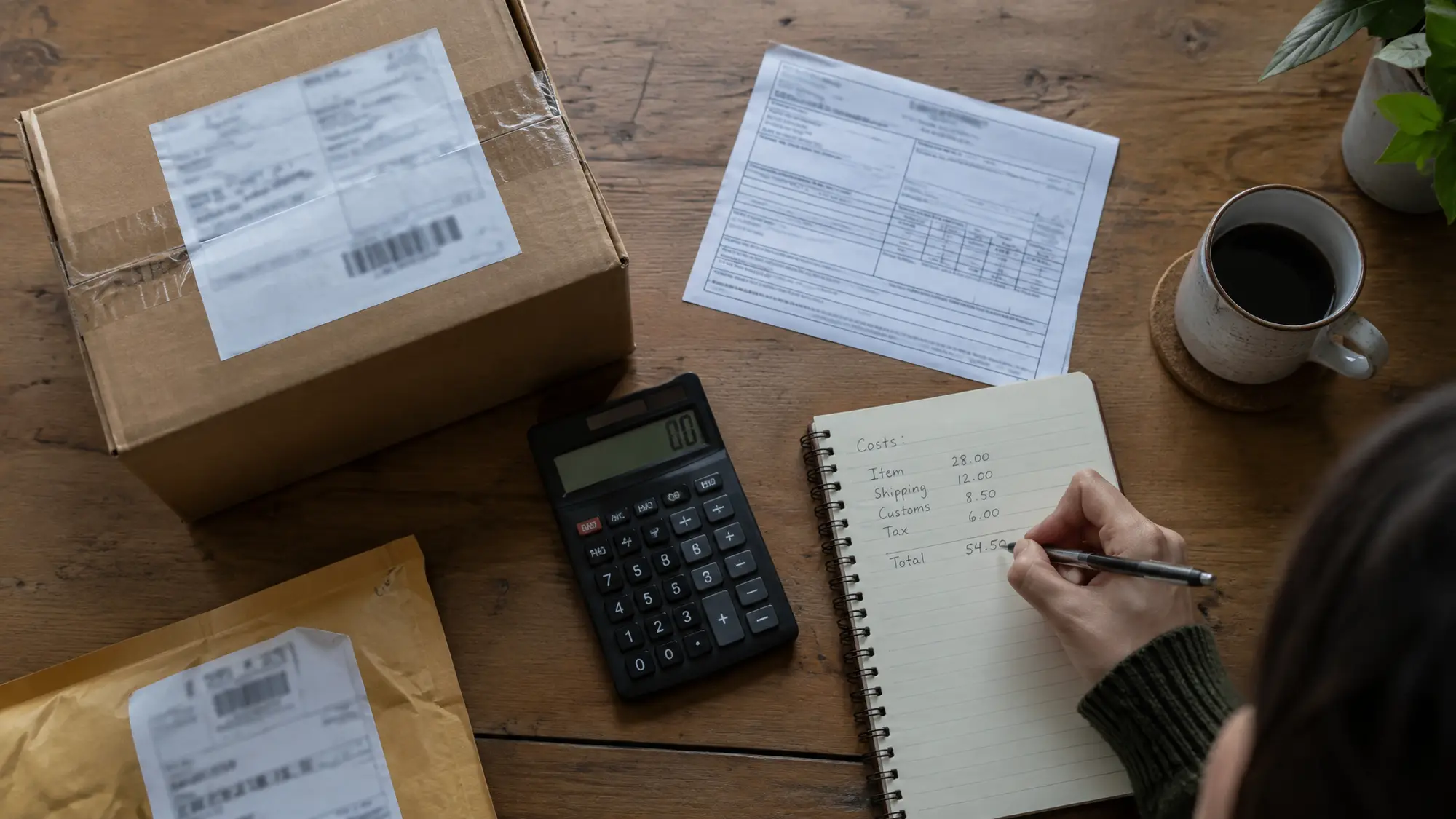
To calculate landed cost, add up everything you pay to get one product to your customer’s door: product price, packaging, handling and quality control, international shipping, customs duties, and any clearance fees. Landed cost = product + packing + handling + shipping + duties + fees. It is the real cost behind your margin, and it is often two to three times the factory price.
This guide breaks down each component, then works through three illustrative examples: a dropshipped order to the US, one to France, and a bulk restock to a local warehouse. If you want to run your own numbers while reading, use the profit margin calculator.
What is included in landed cost?
Landed cost is a per-unit or per-order figure. For a dropshipping or fulfilment order shipped from China, it usually includes:
Component
What it covers
Often forgotten?
Product price
Unit price from the factory or supplier
No
Domestic freight in China
Supplier to your agent’s warehouse, shared across units
Yes
Packaging
Poly mailer, box, inserts, branded packaging
Sometimes
Handling / pick and pack
Receiving, storing, picking and packing the order
Sometimes
Quality control
Inspection per unit or per batch
Yes
International shipping
Air express line priced by chargeable weight
No
Customs duty
Duty on the declared value, or a flat duty where it applies
Yes
Clearance / carrier fees
Fees some carriers charge to clear or collect duties
Yes
Import VAT / sales tax
Collected at checkout or at the door, depending on the market
Often misunderstood
Swipe sideways to see the whole table
Payment fees and advertising are not part of landed cost. They belong in your profit calculation, which starts from landed cost. See dropshipping profit margin for the next step.
How to calculate landed cost step by step
Start with the unit price, in the currency you pay the supplier. Add a per-unit share of domestic freight if your supplier charges it separately.
Add packaging and inserts per order. Branded boxes and printed cards are small per unit but add up.
Add your agent’s handling, pick and pack and QC fees per order.
Get the shipping rate for that weight and destination.
Add customs duty and clearance fees for the destination, whether you pay them upfront (DDP) or the customer pays them at delivery.
Handle VAT or sales tax separately, as explained below, so you do not count it twice.
Landed cost example: one order shipped to the US
Since the US suspended duty-free de minimis treatment for all countries on 29 August 2025, low-value parcels pay duties, taxes and fees. The exact duty depends on the product, its classification and current tariff rules, so the rate below is only an illustration, not a real rate for any product.
Line
Amount (illustrative)
Product (unit price)
$6.20
Packaging and insert
$0.40
Pick, pack and handling
$1.00
QC
$0.30
Air express shipping, ~350 g chargeable
$7.10
Duty, assuming 30% of a $6.20 customs value
$1.86
Clearance fee charged by the carrier (example)
$1.00
Landed cost per order
$17.86
A $6.20 product lands at almost $18. Sold at $39.99, that leaves about $22 before payment fees and ads. Check your real duty rate and how your shipping line handles US duties with your agent, and read the end of US de minimis for the details.
Landed cost example: one order shipped to the EU
In the EU, three things matter for parcels up to €150. First, VAT applies to all imports, and sellers using the IOSS scheme collect it at checkout. Second, since 1 July 2026, a temporary €3 customs duty applies per item category in a consignment, until 1 July 2028. Third, since 1 November 2026, an EU handling fee of €2 per item comes on top.
Line
Amount (illustrative)
Product
€5.70
Packaging and insert
€0.40
Pick, pack and handling
€0.90
QC
€0.30
Air express shipping to France
€6.80
EU customs duty, one item category
€3.00
EU handling fee, one item
€2.00
Landed cost per order (excl. VAT)
€19.10
What about VAT? With IOSS, VAT is charged on the price the customer pays and collected at checkout. It is not a cost you pay the supplier, but it is not your money either. On a €34.90 sale in France at 20% VAT, about €5.82 goes to VAT and your net revenue is €29.08. Compare that €29.08 with the €19.10 landed cost. Our guide to customs, VAT and duties for dropshipping covers the rules by market.
How to calculate landed cost per unit for bulk stock
When you move to holding stock in a local warehouse, you calculate landed cost per unit for the whole shipment, then add last-mile delivery per order. This is the one case where sea freight becomes an option to compare, because you are moving cartons, not parcels. An illustrative air shipment of 300 units to a US warehouse:
Cost
Total
Per unit
Products (300 × $4.10)
$1,230
$4.10
Domestic freight + QC
$85
$0.28
Air freight, 130 kg chargeable at $6/kg (example)
$780
$2.60
Duty, assuming 30% of goods value
$369
$1.23
Customs broker and fees (example)
$150
$0.50
Warehouse receiving
$45
$0.15
Landed cost to warehouse
$2,659
$8.86
Swipe sideways to see the whole table
Then add the per-order costs from the warehouse, for example $2.50 pick and pack and $5.50 domestic shipping, for about $16.86 per order. Split freight by chargeable weight when a shipment has several products. Sea freight usually lowers the freight line but adds weeks of transit and ties up cash for longer.
Common landed cost mistakes
Using the product weight instead of the packed, volumetric weight.
Forgetting duties because “parcels under $800 are duty-free”. That US rule is suspended.
Counting VAT as a cost and also subtracting it from revenue, or ignoring it entirely.
Using one shipping rate for every country. Rates to the US, the UK, France and Australia can differ a lot.
Forgetting exchange rates. If you pay in USD and sell in EUR, convert at a realistic rate with a small buffer.
Not updating the calculation when rates change. Recheck landed cost every time you get a new shipping rate card or customs rule.
Your next step
Pick your main product and main market, weigh a packed sample, and fill in each line above with real quotes. Enter them in the profit margin calculator, then use the result as the starting point for your price and break-even ROAS. If you do not have reliable shipping and duty numbers yet, an agent such as Jindouyun can quote landed cost for a product link and destination.
FAQ
What is the formula for landed cost?
Landed cost = product price + packaging + handling and QC + international shipping + customs duties + clearance or carrier fees. For bulk shipments, add every cost of the shipment and divide by the number of units, then add last-mile delivery per order. VAT or sales tax is usually handled separately from landed cost.
Does landed cost include VAT?
It depends on how you account for it. For EU sales under IOSS, VAT is collected from the customer at checkout and paid to the tax authority, so most sellers keep it out of landed cost and subtract it from revenue instead. What matters is counting it exactly once, never twice and never zero times.
Do I pay customs duty on small parcels to the US?
Yes, in most cases. The US suspended duty-free de minimis treatment for shipments from all countries on 29 August 2025, so parcels valued at $800 or less now pay applicable duties, taxes and fees. The amount depends on the product and current tariff rules, so confirm it with your agent or carrier.
How much does the EU €3 customs duty add?
From 1 July 2026 until 1 July 2028, the EU applies a flat €3 customs duty per item category in low-value consignments up to €150. A parcel with one product type pays €3; a parcel mixing different product categories can pay more. Since 1 November 2026 a separate EU handling fee of €2 per item is added. VAT is still due on top.